
NEIGHBORHOOD GUIDE
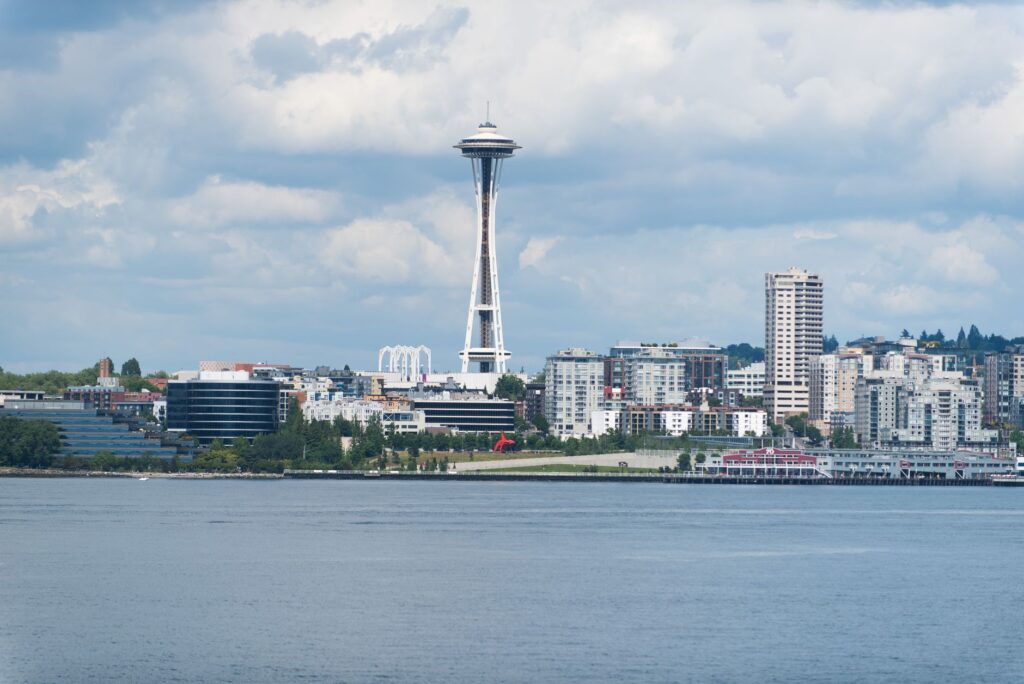
Queen Anne is one neighborhood with two very different personalities, and a listing that just says Queen Anne will not tell you which one you are getting. Most people searching for Queen Anne apartments in Seattle are looking at one of two places: Upper Queen Anne, the residential district on top of the hill, or Lower Queen Anne, the flat area at the base that the city now calls Uptown.
This guide walks through the geography, the history behind the split, and the real differences in commute, daily errands, and feel, so you can decide which part of Queen Anne fits how you actually live. Rejuvenate Apartments is in Lower Queen Anne, about a block from Seattle Center, so we will be clear about where that puts you on the map.
The short version
- Queen Anne has two parts: Upper Queen Anne on top of the hill, quiet and residential with a shopping street along Queen Anne Avenue North, and Lower Queen Anne, officially named Uptown, at the flat base next to Seattle Center.
- Upper Queen Anne trades walkable attractions for calm streets and hilltop views. Lower Queen Anne trades quiet for being steps from arenas, museums, theaters, and frequent transit.
- The hill between them is steep. The historic Queen Anne Counterbalance, an underground streetcar system, was built in 1901 just to climb it.
- Lower Queen Anne is flatter and better connected. The RapidRide D Line and the Seattle Center Monorail both run from here, and downtown is a short ride away.
- Rejuvenate Apartments sits in Lower Queen Anne (Uptown) at 201 Queen Anne Avenue North, about a block from the edge of the Seattle Center campus.
Upper or Lower Queen Anne: what is the difference?
Upper Queen Anne is the residential area on top of Queen Anne Hill, built around a walkable shopping stretch of Queen Anne Avenue North. Lower Queen Anne, which the city officially renamed Uptown in 2021, is the flatter area at the southern base of the hill, wrapped around the Seattle Center campus. Upper is quieter and more removed, while Lower has more going on and better transit.
The two share a name because they sit on the same hill, but they feel like separate neighborhoods. Upper Queen Anne is where you go for a residential street with older homes and a compact main street. Lower Queen Anne is where the stadiums, museums, and performing arts venues are, along with the bus lines and the monorail that connect the area to the rest of the city. The grade of the hill is steep enough that getting between the two on foot is a real climb, which is a big part of why they developed such different characters.
Upper Queen Anne: quiet streets at the top of the hill
Upper Queen Anne sits on the crown of the hill and is mostly residential, with a shopping and dining stretch running along Queen Anne Avenue North near the top. It is the calmer side of the neighborhood. You get tree-lined streets, a mix of older houses and apartment buildings, and a main street where you can run errands on foot. In season, the Queen Anne Farmers Market sets up on West Crockett Street at Queen Anne Avenue North on Thursday afternoons, bringing local produce, seafood, and prepared food to the top of the hill.
The trade-off is distance and elevation. Upper Queen Anne is farther from Seattle Center, the waterfront, and light rail, and the hill is steep, so getting down to the flat part of the city and back usually means a bus or a car rather than a casual walk. If your priority is a quiet home base with good neighborhood shops and you do not mind the climb, Upper Queen Anne delivers that. If you want to be in the middle of things, read on to the Lower Queen Anne section.
Local landmark: Kerry Park
One reason people climb Queen Anne Hill is Kerry Park, a small viewpoint on Highland Drive. Facing south, it frames the Space Needle, the downtown skyline, Elliott Bay, and, on clear days, Mount Rainier. The viewpoint parcel was given to the city by Albert and Katherine Kerry in 1927. Parking nearby is limited, so many visitors walk in or park a few blocks away.
Lower Queen Anne (Uptown): flat and next to Seattle Center
Lower Queen Anne, now called Uptown, is the flat neighborhood at the base of the hill next to Seattle Center. From here you are within walking distance of Climate Pledge Arena, the Space Needle, the Museum of Pop Culture, and the Pacific Science Center, along with performing arts venues such as Seattle Repertory Theatre and the Pacific Northwest Ballet, and you are close to frequent bus service and the monorail.
Seattle Center is the anchor. The campus covers about 74 acres and holds more than 30 arts, cultural, and educational organizations, which is why the city named Uptown one of its official Arts and Cultural Districts in 2017. Day to day, that means a flat, walkable area with grocery stores, restaurants, coffee, and a steady calendar of games, concerts, festivals, and performances a few minutes from your door. You can read more on our neighborhood page.
Rejuvenate Apartments is at 201 Queen Anne Avenue North, about a block west of the Seattle Center campus edge. The Space Needle at 400 Broad Street and Climate Pledge Arena are both a short walk away. The building is an office-to-residential conversion with a loft feel: high ceilings, large windows, smart-home features, and energy-efficient systems across its 74 studio and one-bedroom style homes, including north-facing studios. You can see the spaces on our gallery and review the amenities.
Living next to a major venue
Being steps from an arena is the main draw of Lower Queen Anne and also something to plan around. On game and concert nights, expect more foot traffic, busier sidewalks, and heavier street traffic in the hours before and after events. Many residents treat it as a feature, since the energy and the easy walk home are the point, but it is worth weighing if you prefer a consistently quiet street.
The Counterbalance: the hill that shaped the neighborhood
The split between Upper and Lower Queen Anne comes down to one thing: the hill is steep. Early electric streetcars could not get enough traction to climb Queen Anne Avenue North on their own, so in 1901 the city built the Queen Anne Counterbalance, an underground counterweight system that ran between Roy and Comstock streets. Weighted cars rode in tunnels beneath the tracks and were linked to the trolleys by cable. Going up, the counterweight gave the streetcar a boost worth about 16 tons; going down, it acted as a brake.
The hill was so steep that streetcars needed a hidden counterweight just to reach the top. The tunnels are still down there.
The Counterbalance ran until 1940, when trackless trolley buses took over and the last counterweight car made its climb. The streetcars are long gone, but the name stuck, and locals still call the lower stretch of Queen Anne Avenue North the Counterbalance. It is a useful reminder when you apartment hunt here: the geography that made the engineering necessary is the same geography that still separates quiet Upper Queen Anne from busy, flat Lower Queen Anne today.
Rent, commute, and daily life: how the two parts compare
Rents in Queen Anne move with the building, the floor plan, and the time of year rather than a neat Upper-versus-Lower rule, so the most reliable number is always a current quote on a specific home. What does differ in a predictable way is the day to day: how you get around, how far you walk to the things you use, and how quiet the street is. The table below sums up the practical contrasts, and the comparison after it goes a little deeper.
| Factor | Upper Queen Anne | Lower Queen Anne (Uptown) |
|---|---|---|
| Terrain | On top of the hill, steep streets | Flat, at the base of the hill |
| Setting | Residential and quieter | Next to Seattle Center, more activity |
| Walk to Seattle Center | A longer walk or short ride downhill | About a block from the campus edge |
| Transit | Mostly buses up and down the hill | RapidRide D Line and the monorail nearby |
| Everyday errands | Shops and cafes along Queen Anne Avenue North | Grocery, dining, and venues close by |
| Best if you want | Calm streets and hilltop views | To be near events, transit, and the water side of the city |
Upper Queen Anne
- On top of Queen Anne Hill
- Residential streets with older homes
- A shopping stretch along Queen Anne Avenue North
- Kerry Park viewpoint and a seasonal Thursday farmers market
- Quieter, but farther from venues and light rail
- You rely more on buses or a car to get up and down the hill
Lower Queen Anne (Uptown)
- At the flat base of the hill
- Wrapped around the Seattle Center campus
- Walking distance to the arena, museums, and theaters
- RapidRide D Line and the Seattle Center Monorail nearby
- More foot traffic, especially on event nights
- Easier walking and biking because it is flat
Getting around Queen Anne without a car
Transit is one of the clearest differences between the two parts of the neighborhood. Lower Queen Anne is served by King County Metro’s RapidRide D Line, which runs between downtown Seattle and Crown Hill by way of Uptown, Interbay, and Ballard, with frequent service through the day and buses operating around the clock. Stops along Queen Anne Avenue North and First Avenue North put a downtown-bound bus within easy reach.
There is also the Seattle Center Monorail, which runs from Seattle Center to Westlake Center downtown in about two minutes, roughly every ten minutes. At Westlake you can connect to the Link light rail network. Upper Queen Anne, by contrast, depends more on buses that climb the hill, so if a car-light commute matters to you, the flat, better-connected lower neighborhood has the edge.
Tip for the car-free
If you plan to walk and bike for most trips, the flat ground in Lower Queen Anne makes a real difference. Errands, the arena, and the monorail are all reachable on foot, and you avoid the steep grade every time you come home. Save the hill climb for the days you actually want the Kerry Park view.
How to choose between Upper and Lower Queen Anne
- Decide what you value moreBe honest about quiet versus access. Upper Queen Anne rewards people who want calm residential streets. Lower Queen Anne rewards people who want venues, dining, and transit within a short walk.
- Map your real commuteCheck how you would actually get to work or school from each area. The RapidRide D Line and the monorail give Lower Queen Anne a head start if you want to skip driving.
- Weigh the hillThe grade between the two is steep. If you will be moving between the base of the hill and the top often, that climb adds up, and it may settle the question on its own.
- Think about event nightsLiving near Seattle Center means crowds on game and concert days. Decide whether that is energy you want close by or noise you would rather keep at a distance.
- Tour both and compare homesFloor plans and pricing vary by building, so see spaces in person or online before deciding. Check current openings on our availability page and ask leasing about any specials.
Frequently asked questions
Is Lower Queen Anne the same as Uptown?
Yes. Uptown is the official name for the neighborhood long known as Lower Queen Anne, the flat area at the base of the hill around Seattle Center. Seattle formally adopted the Uptown name in 2021, and the city designated it an Arts and Cultural District in 2017. You will still see both names used on listings and signs.
Which is cheaper, Upper or Lower Queen Anne?
There is no reliable rule, because rent depends on the building, the floor plan, the floor, and the season more than on which part of the hill you pick. Both areas have a range of options. The most accurate way to compare is to look at current quotes on specific homes rather than a neighborhood average.
How far is Rejuvenate Apartments from Seattle Center?
The building is at 201 Queen Anne Avenue North, about a block west of the Seattle Center campus edge. From there it is a short walk to the Space Needle at 400 Broad Street and to Climate Pledge Arena, plus the museums and theaters on the grounds. It is one of the closest residential spots to the campus.
Is Queen Anne a walkable neighborhood?
Lower Queen Anne is very walkable because it is flat, with grocery, dining, and venues close together. Upper Queen Anne has its own walkable main street along Queen Anne Avenue North. The catch is the hill between them, which is steep enough that walking from one to the other is a workout rather than a stroll.
What was the Queen Anne Counterbalance?
It was an underground counterweight system, built in 1901, that helped electric streetcars climb the steep grade of Queen Anne Avenue North. Weighted cars in tunnels were cabled to the trolleys to push them up and brake them going down. It ran until 1940, and the lower avenue is still nicknamed the Counterbalance.
Does Queen Anne have good public transit?
Lower Queen Anne does. The RapidRide D Line runs from downtown through Uptown to Ballard and Crown Hill with frequent, around-the-clock service, and the Seattle Center Monorail reaches downtown Westlake in about two minutes, connecting to light rail. Upper Queen Anne relies more on buses that climb the hill.
Are there affordable apartments in Queen Anne?
Rejuvenate Apartments includes a number of income-restricted homes alongside its market-rate units. Eligibility is based on income limits set by the program, and those figures change, so the current details and how to apply are listed on our affordable housing page rather than quoted here.
See what is open in Lower Queen Anne
Rejuvenate is in Uptown at 201 Queen Anne Avenue North, about a block from Seattle Center. Current specials include no rent until January 2027 on select north-facing studios and four weeks free rent on other select units. Eligibility and lease terms apply, and offers are subject to change. Ask leasing for current details.
Sources
- Queen Anne Counterbalance Streetcar, HistoryLink
- Lower Queen Anne, Seattle (Wikipedia)
- Arts and Cultural Districts, Seattle Office of Arts and Culture
- Mayor announces new cultural district in Uptown (2017), Seattle Office of Arts and Culture
- Seattle Center Monorail (Wikipedia)
- RapidRide D Line (Wikipedia)
- Queen Anne Farmers Market
- Kerry Park and Viewpoint, Seattle Parks via Friends of Seattle's Olmsted Parks
- Space Needle (Wikipedia)
Neighborhood details, transit schedules, market dates, and event calendars change. Confirm current times, routes, and specials with official sources and with leasing before you rely on them. Rent and income limits are not quoted here because they vary and change over time.